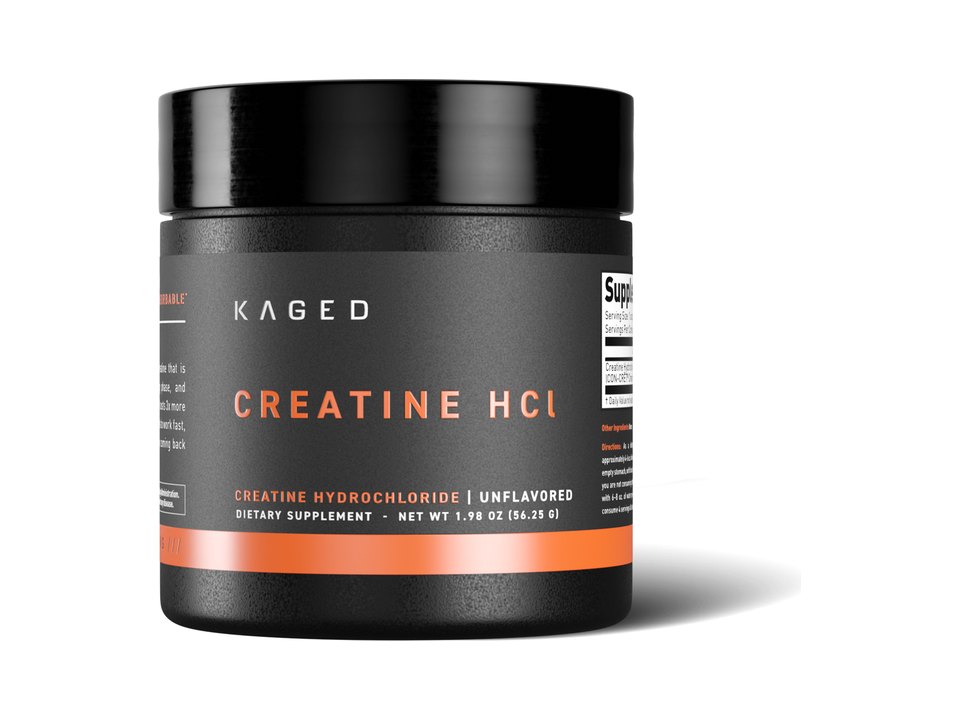
Product imagery supplied by the retailer. Packaging may vary — verify the Supplement Facts panel on the container you receive.
Kaged
Creatine HCl
Our analysis — editorial take, not from the label
750 mg of creatine HCl per roughly 1 g scoop with every batch tested by Informed Sport; also sold in capsule form.
- Creatine
- 0.75 g
- Form
- HCl
- Servings
- 75
Price tier: Mid-range · relative cost per full serving across this database
We don't list dollar prices — they change daily and go stale. Check the live price instead:
View current price at Amazon Compare all creatine productsScoop Sense doesn't collect user reviews and won't invent them. Read customer reviews on Amazon
Affiliate links — Scoop Sense may earn a commission at no additional cost to you.
Unflavored, Fruit Punch, and Lemon Lime; flavored versions use stevia and sucralose, and the plain powder is notably tart.
Label verified: July 2026 · View label source
Label data
Per full serving · 75 servings per container · from the manufacturer's panel
| Creatine per serving | 0.75 g |
|---|---|
| Form | HCl |
| Creatine HCl | 750 mg |
| Proprietary blend | No |
Primary label source: Kaged product page · verified July 2026
Cautions
- Most long-term saturation research was done on monohydrate, not HCl
- Draws water into muscle — drink more water
- Talk to your doctor if you have kidney conditions
Formulated for healthy adults — not intended for anyone under 18. Full health & safety notes
Product details
Where this label sits
Kaged Creatine HCl is one of the creatine products in the Scoop Sense database. It runs 75 servings per container at the full labeled serving. Everything on this page comes from the manufacturer's supplement facts panel as of July 2026 — never from the marketing page.
Key ingredients & studied doses
- Creatine HCl · 750 mg. A hydrochloride salt of creatine studied for high water solubility, which is why the labeled serving is much smaller than a monohydrate scoop.
Flavors & sweetener
Unflavored, Fruit Punch, and Lemon Lime; flavored versions use stevia and sucralose, and the plain powder is notably tart.
Who it's best for
People who prefer a smaller powder dose; note that HCl has a thinner research base than monohydrate. Derived from the label figures above — not medical advice.
How we log this label
Every entry is built the same way: we read the current supplement facts panel, log each disclosed dose, compare it against the amounts used in published research, flag proprietary blends, and state the cautions plainly. The full methodology explains each step.
This label against the research
How we evaluate labelsEach bar shows the amount commonly used in published human research, and where this label's dose falls against it. Research amounts are context, not a recommendation — they are not doses, and nothing here is medical advice. The bars compare what the label states; we do not laboratory-test the product to confirm it.
-
Creatine HCl0.75 g
Creatine HCl has no established studied dose of its own. Brands serve it at a fraction of the monohydrate amount on a solubility argument that head-to-head research has not settled.
-
Creatine0.75 g
The 3–5 g studied range is monohydrate research. This label uses another form, which has no separately established studied dose — the amounts are not interchangeable.
Source: Kreider et al., Journal of the International Society of Sports Nutrition 2017 — “Once muscle creatine stores are fully saturated, creatine stores can generally be maintained by ingesting 3–5 g/day”
Common questions about Kaged Creatine HCl
Do I need a loading phase with Kaged Creatine HCl?
The loading question does not transfer to this form. Saturation timelines come from research on 3–5 g of creatine monohydrate daily; HCl has no established studied dose of its own, so there is no figure to load toward. Treat the label's 0.75 g as the brand's recommendation rather than a researched one.