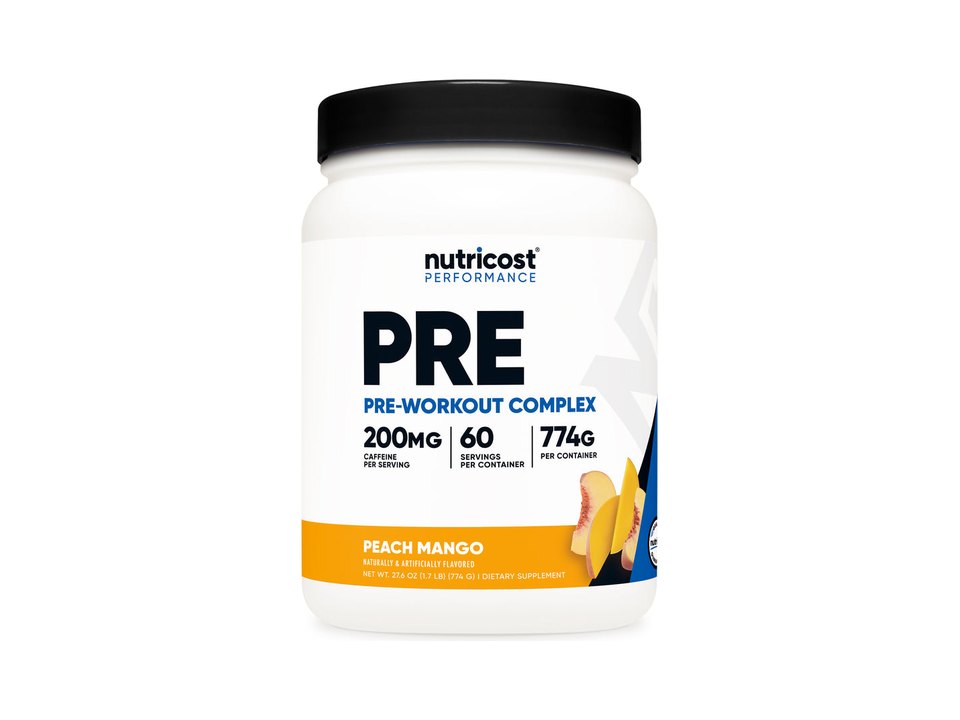
Product imagery supplied by the retailer. Packaging may vary — verify the Supplement Facts panel on the container you receive.
Nutricost
Pre-Workout Complex
Our analysis — editorial take, not from the label
A fully disclosed, no-proprietary-blend label at one of the lowest per-serving prices in the category — every dose from 4g citrulline to 200mg caffeine is printed in exact milligrams rather than hidden in a blend.
- Caffeine
- 200 mg
- Citrulline
- 4 g
- Beta-alanine
- 2 g
- Servings
- 60
Price tier: Budget · relative cost per full serving across this database
We don't list dollar prices — they change daily and go stale. Check the live price instead:
View current price at Amazon Compare all 51 pre-workoutsScoop Sense doesn't collect user reviews and won't invent them. Read customer reviews on Amazon
Affiliate links — Scoop Sense may earn a commission at no additional cost to you.
Available in seven flavors — Blue Raspberry, Fruit Punch, Peach Mango, Strawberry Margarita, Watermelon Candy, Cotton Candy, and Strawberry Kiwi — sweetened with sucralose, in both 30-serving and 60-serving tubs.
Label verified: July 2026 · View supplement facts image
Label data
Per full serving · 60 servings per container · from the manufacturer's panel
| Caffeine | 200 mg |
|---|---|
| L-Citrulline | 4 g |
| Beta-Alanine | 2 g |
| Nitrosigine (Inositol-Stabilized Arginine Silicate) | 750 mg |
| Proprietary blend | No |
Primary label source: Nutricost — Pre-Workout Complex (official product page, seven flavors, 30 and 60 serving sizes) · verified July 2026
Cautions
- 200mg caffeine (about two cups of coffee) from a single 13g scoop; the label instructs not to exceed 1 scoop in any 24-hour period.
- 2g beta-alanine may cause a temporary tingling or flushing sensation.
- Also stacks 100mg theobromine, 150mg DMAE bitartrate, 100mg Alpha GPC and 200mcg huperzine A alongside the caffeine — additional stimulant-adjacent and nootropic compounds beyond caffeine alone.
Formulated for healthy adults — not intended for anyone under 18. Performance studies use roughly 3–6 mg of caffeine per kg of body weight, which puts 200 mg at the studied amount for a 33–67 kg adult. Full health & safety notes
Product details
Where this label sits
Nutricost Pre-Workout Complex sits in the moderate stim tier of the Scoop Sense pre-workout database, which spans 0–400 mg of caffeine per serving. Every active ingredient on the panel is listed with its own dose — nothing is hidden inside a blend total. It runs 60 servings per container at the full labeled serving. Everything on this page comes from the manufacturer's supplement facts panel as of July 2026 — never from the marketing page.
Key ingredients & studied doses
- L-Citrulline · 4 g. Below the 6-8g of citrulline malate typically used in pump research, though this is straight L-citrulline rather than the malate form, which changes the gram-for-gram comparison.
- Beta-Alanine · 2 g. About half the 3.2-6.4g daily amount used in beta-alanine loading studies; still enough at this dose to produce the characteristic tingling.
- Nitrosigine (Inositol-Stabilized Arginine Silicate) · 750 mg. Half the 1,500mg daily amount used in most of Nitrosigine's published blood-flow research, though 750mg has appeared in some single-dose studies.
- Caffeine Anhydrous · 200 mg. Roughly two cups of coffee worth of stimulant.
Flavors & sweetener
Available in seven flavors — Blue Raspberry, Fruit Punch, Peach Mango, Strawberry Margarita, Watermelon Candy, Cotton Candy, and Strawberry Kiwi — sweetened with sucralose, in both 30-serving and 60-serving tubs.
Who it's best for
Most regular gym-goers — the caffeine dose is in the range of about two cups of coffee. A reasonable pick when cost per serving matters. Derived from the label figures above — not medical advice.
How we log this label
Every entry is built the same way: we read the current supplement facts panel, log each disclosed dose, compare it against the amounts used in published research, flag proprietary blends, and state the cautions plainly. The full methodology explains each step.
This label against the research
How we evaluate labelsEach bar shows the amount commonly used in published human research, and where this label's dose falls against it. Research amounts are context, not a recommendation — they are not doses, and nothing here is medical advice. The bars compare what the label states; we do not laboratory-test the product to confirm it.
-
Citrulline4 g
67% of the low end of the studied range0studied range 6 g–8 g10 g
Studies use about 6 g of pure L-citrulline, or 8 g of citrulline malate — which is about 5.3 g of citrulline at the usual 2:1 ratio, and closer to 4 g if the label is 1:1.
Source: Gough et al., European Journal of Applied Physiology 2021 — “The most commonly employed dose of CM is a single acute 8 g dose”
-
Beta-alanine2 g
63% of the low end of the studied range0studied range 3.2 g–6.4 g7 g
Studied as a daily loading protocol of 3.2–6.4 g taken for four weeks or longer. A single serving below that range still counts toward the daily total, but one scoop is not a studied dose on its own.
Source: Rezende et al., Frontiers in Physiology 2020 — “It seems that substantial amounts of BA are required to increase MCarn, with most studies using doses of ~3.2–6.4 g·day−1, for periods ranging from 4 to 24 weeks.”
-
Nitrosigine0.75 g
50% of the low end of the studied range0studied range 1.5 g2 g
The manufacturer's own published work uses 1.5 g, and formulas that include it generally match that amount.
Source: Kalman et al., Nutrients 2016 — “The active treatment contained 1500 mg of ASI (arginine, silicon, inositol and potassium)”
-
Caffeine200 mg
At or above the studied amount0studied range 200 mg–400 mg450 mg
Performance studies most often use 3–6 mg per kg of body weight, which works out to roughly 200–400 mg for most adults. The FDA cites 400 mg a day as an amount not generally associated with negative effects in healthy adults.
Source: Guest et al., Journal of the International Society of Sports Nutrition 2021 — “Caffeine has consistently been shown to improve exercise performance when consumed in doses of 3–6 mg/kg body mass.”
Common questions about Nutricost Pre-Workout Complex
How much caffeine is in Nutricost Pre-Workout Complex?
200 mg per full labeled serving — roughly 2.1 small cups of coffee. Within the Scoop Sense pre-workout database (0–400 mg per serving) that places it in the moderate stim tier. The FDA cites about 400 mg per day as an amount generally not associated with negative effects in healthy adults, and coffee, tea, and energy drinks count toward the same total.
Why does Nutricost Pre-Workout Complex make my skin tingle?
The 2 g of beta-alanine. The prickling (paresthesia) in the face, neck, and hands is generally considered harmless, is dose-dependent, and fades on its own — typically within about an hour. Most beta-alanine studies use 3.2 g per day.
Does Nutricost Pre-Workout Complex disclose every dose?
Yes — the label lists an individual amount for each ingredient, with no proprietary blends. That is what the "label fully disclosed" tag on Scoop Sense means, and it is what lets each dose be compared against the amounts used in published research.
Do the numbers for Nutricost Pre-Workout Complex assume one scoop or two?
All figures on this page are per full labeled serving. 200mg caffeine (about two cups of coffee) from a single 13g scoop; the label instructs not to exceed 1 scoop in any 24-hour period..