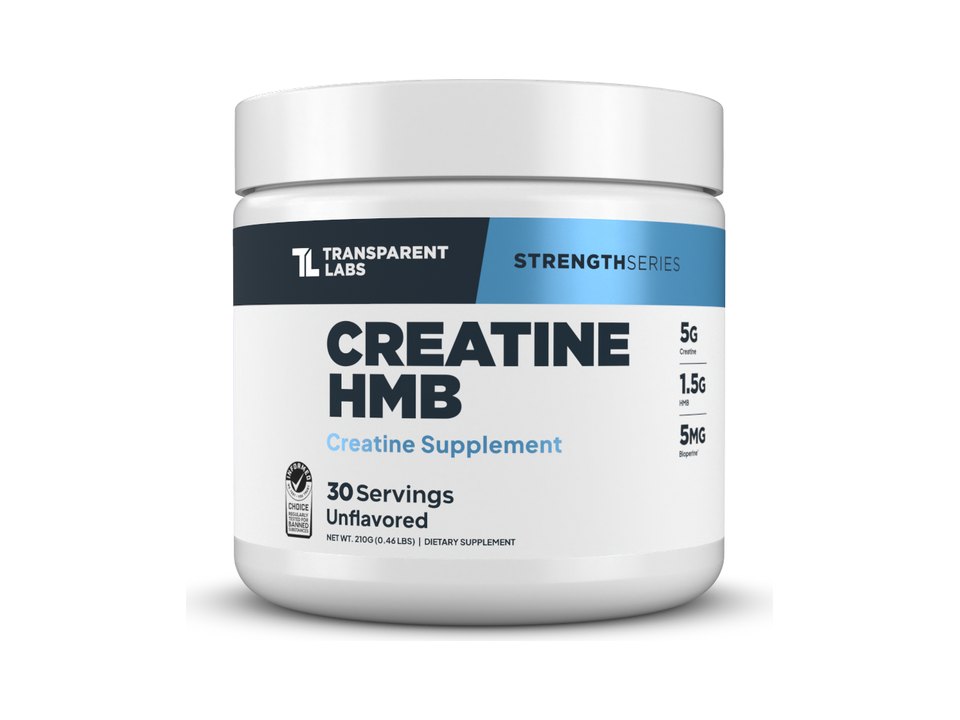
Product imagery supplied by the retailer. Packaging may vary — verify the Supplement Facts panel on the container you receive.
Transparent Labs
Creatine HMB
Our analysis — editorial take, not from the label
Pairs a full 5 g of monohydrate with 1.5 g myHMB, vitamin D3, and BioPerine; Informed Choice certified, and priced well above plain monohydrate.
- Creatine
- 5 g
- Form
- monohydrate
- Servings
- 30
Price tier: Premium · relative cost per full serving across this database
We don't list dollar prices — they change daily and go stale. Check the live price instead:
View current price at Amazon Compare all creatine productsScoop Sense doesn't collect user reviews and won't invent them. Read customer reviews on Amazon
Affiliate links — Scoop Sense may earn a commission at no additional cost to you.
Thirteen options from Unflavored to Blue Raspberry and Peach Mango, with no artificial sweeteners, colors, or preservatives.
Label verified: July 2026 · View label source
Label data
Per full serving · 30 servings per container · from the manufacturer's panel
| Creatine per serving | 5 g |
|---|---|
| Form | monohydrate |
| Creatine Monohydrate | 5 g |
| myHMB (beta-hydroxy beta-methylbutyrate) | 1.5 g |
| Vitamin D3 | 12.5 mcg (500 IU) |
| BioPerine black pepper extract | 5 mg |
| Proprietary blend | No |
Primary label source: Transparent Labs product page · verified July 2026
Cautions
- Draws water into muscle — drink more water
- Contains vitamin D — count it toward your total daily intake across supplements
- Talk to your doctor if you have kidney conditions
Formulated for healthy adults — not intended for anyone under 18. Full health & safety notes
Product details
Where this label sits
Transparent Labs Creatine HMB is one of the creatine products in the Scoop Sense database. Every active ingredient on the panel is listed with its own dose — nothing is hidden inside a blend total. It runs 30 servings per container at the full labeled serving. Everything on this page comes from the manufacturer's supplement facts panel as of July 2026 — never from the marketing page.
Key ingredients & studied doses
- Creatine Monohydrate · 5 g. The most-studied creatine form, researched for supporting strength, power, and ATP recycling during high-intensity exercise.
- myHMB (beta-hydroxy beta-methylbutyrate) · 1.5 g. A leucine metabolite studied for supporting retention of lean mass during hard training blocks.
- Vitamin D3 · 12.5 mcg (500 IU). Studied for its role in normal muscle function and bone maintenance.
- BioPerine black pepper extract · 5 mg. A standardized black pepper fruit extract studied for supporting absorption of co-ingested nutrients.
Flavors & sweetener
Thirteen options from Unflavored to Blue Raspberry and Peach Mango, with no artificial sweeteners, colors, or preservatives.
Who it's best for
Anyone who wants the form with the deepest research base — most creatine studies use 3–5 g of monohydrate daily. Derived from the label figures above — not medical advice.
How we log this label
Every entry is built the same way: we read the current supplement facts panel, log each disclosed dose, compare it against the amounts used in published research, flag proprietary blends, and state the cautions plainly. The full methodology explains each step.
This label against the research
How we evaluate labelsEach bar shows the amount commonly used in published human research, and where this label's dose falls against it. Research amounts are context, not a recommendation — they are not doses, and nothing here is medical advice. The bars compare what the label states; we do not laboratory-test the product to confirm it.
-
Creatine5 g
At or above the studied amount0studied range 3 g–5 g6 g
Maintenance dosing in the research is 3–5 g a day of monohydrate, every day, not only on training days.
Source: Kreider et al., Journal of the International Society of Sports Nutrition 2017 — “Once muscle creatine stores are fully saturated, creatine stores can generally be maintained by ingesting 3–5 g/day”
What other people say
Why we don't rate productsTwo different things, side by side: the rating the seller publishes on its own store, and what independent users write in public threads. Scoop Sense writes neither and collects no reviews of its own. Neither is evidence that a product works — they describe what people experienced and expected, not what the research shows.
On the seller's page
4.8 / 5
3,280 ratings
The brand's own storefront, read July 2026. A seller's rating is collected and moderated by the seller — treat it as a marketing figure, not an independent one.
What people actually report
Users report solid results and easy digestion, but the loudest recurring criticism is that paying extra for the HMB blend is not worth it compared with buying monohydrate and HMB separately.
- negative Value of the HMB add-in. The most common complaint is that the HMB blend costs much more than sourcing plain monohydrate and HMB on their own for a comparable total.
- positive Perceived effectiveness. Some users report noticeably better recovery and more consistent workouts after switching to it.
- positive Stomach tolerance. Recommended by some as an easy-on-the-stomach option when shopping for a gentler creatine.
Read the threads yourself
-
“It's a nasty marketing scheme transparent labs uses where people over pay and it sets a bad precedent in the supplement world”
r/Supplements, "I'm getting tired of Transparent Labs BS." -
“I've noticed my recovery has been better and my workouts feel more consistent. I'm happy with how it's been working for me.”
r/Supplements, "Creatine HMB vs creatine monohydrate, is there a better choice for beginners?" -
“I heard German creatine is very good (eg: Transparent Labs Creatine HMB )”
r/Supplements, "Which Creatine is easy on the stomach?"
Common questions about Transparent Labs Creatine HMB
Do I need a loading phase with Transparent Labs Creatine HMB?
Loading is optional. Research shows a steady 3–5 g of creatine monohydrate daily reaches muscle saturation in about three to four weeks; a loading week of around 20 g per day just gets there faster. This label's 5 g serving sits in that studied range.
Does Transparent Labs Creatine HMB disclose every dose?
Yes — the label lists an individual amount for each ingredient, with no proprietary blends. That is what the "label fully disclosed" tag on Scoop Sense means, and it is what lets each dose be compared against the amounts used in published research.