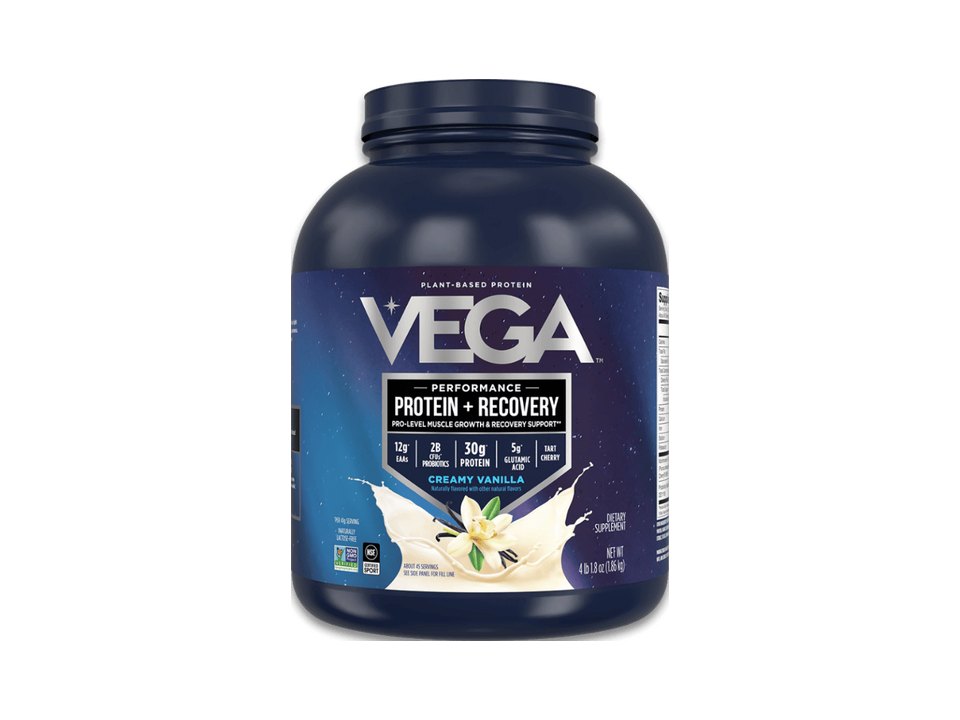
Product imagery supplied by the retailer. Packaging may vary — verify the Supplement Facts panel on the container you receive.
Vega
Protein + Recovery
Our analysis — editorial take, not from the label
The highest per-serving protein of the plant picks at 30 g, with NSF Certified for Sport verification on the brand page — the vegan option for drug-tested athletes. Sold until recently as Vega Sport Premium Protein — same NSF-certified formula family.
- Protein
- 30 g
- Protein by weight
- 68%
- Source
- plant blend
- Servings
- 19
Price tier: Premium · relative cost per full serving across this database
We don't list dollar prices — they change daily and go stale. Check the live price instead:
View current price at Amazon Compare all protein powdersScoop Sense doesn't collect user reviews and won't invent them. Read customer reviews on Amazon
Affiliate links — Scoop Sense may earn a commission at no additional cost to you.
Figures verified against Chocolate (44 g scoop, 19-serving tub); stevia-sweetened, and newest packaging carries the 'Protein + Recovery' name on the same formula.
Label verified: July 2026 · View label source
Label data
Per full serving · 19 servings per container · from the manufacturer's panel
| Protein per serving | 30 g |
|---|---|
| Serving size | 44 g |
| Protein per scoop | 68% |
| Calories | 170 |
| Total carbohydrate | 6 g |
| Total fat | 3 g |
| Source | plant blend |
| Sweetener | stevia |
| Plant protein blend (pea protein, pumpkin seed protein, organic sunflower seed protein) | 30 g |
| Naturally occurring BCAAs | 5 g |
| Tart cherry + probiotics (2 billion CFU) | amount not stated on label |
| Proprietary blend | Total only — source ratio undisclosed |
Primary label source: Vega product page (protein, servings, NSF Certified for Sport) · verified July 2026
Cautions
- 44 g serving is large — mixes best in 10-12 oz of liquid
- Check the label if you're sensitive to stevia
- Protein powders supplement food, not replace it
Formulated for healthy adults — not intended for anyone under 18. Full health & safety notes
Product details
Where this label sits
Vega Protein + Recovery is one of the protein powders in the Scoop Sense database. The label uses at least one proprietary blend, so a blend total stands in place of the individual amounts inside it. It runs 19 servings per container at the full labeled serving. Everything on this page comes from the manufacturer's supplement facts panel as of July 2026 — never from the marketing page.
Key ingredients & studied doses
- Plant protein blend (pea protein, pumpkin seed protein, organic sunflower seed protein) · 30 g. A multi-source plant blend delivering a complete amino-acid profile to support muscle repair after training.
- Naturally occurring BCAAs · 5 g. Branched-chain amino acids from the protein sources themselves.
- Tart cherry + probiotics (2 billion CFU) · amount not stated on label. Recovery-oriented extras printed on the label; the probiotic is a heat-stable Bacillus subtilis strain.
Flavors & sweetener
Figures verified against Chocolate (44 g scoop, 19-serving tub); stevia-sweetened, and newest packaging carries the 'Protein + Recovery' name on the same formula.
Who it's best for
A standard-ratio powder — fine as a food supplement when total daily protein is what matters. Suits anyone avoiding dairy. Skip it if you want every individual dose disclosed on the label. Derived from the label figures above — not medical advice.
How we log this label
Every entry is built the same way: we read the current supplement facts panel, log each disclosed dose, compare it against the amounts used in published research, flag proprietary blends, and state the cautions plainly. The full methodology explains each step.
This label against the research
How we evaluate labelsEach bar shows the amount commonly used in published human research, and where this label's dose falls against it. Research amounts are context, not a recommendation — they are not doses, and nothing here is medical advice. The bars compare what the label states; we do not laboratory-test the product to confirm it.
-
Protein30 g
At or above the studied amount0studied range 20 g–40 g50 g
Per-meal doses studied for muscle protein synthesis run about 20–40 g of high-quality protein, with the upper half of that range favoured for larger athletes and older adults.
Source: Jäger et al., Journal of the International Society of Sports Nutrition 2017 — “General recommendations are 0.25 g of a high-quality protein per kg of body weight, or an absolute dose of 20–40 g.”
-
Leucine2.4 g
At or above the studied amount0studied range 0.7 g–3 g4 g
The ISSN position stand puts an acute protein dose at 700–3000 mg of leucine, and about 1–3 g per meal as the amount needed to stimulate protein translation. Higher-leucine servings sit at the top of that span rather than beyond it.
Source: Jäger et al., Journal of the International Society of Sports Nutrition 2017 — “Acute protein doses should strive to contain 700–3000 mg of leucine and/or a higher relative leucine content”
One or more amounts on this label sit inside a proprietary blend, so the individual doses behind the blend total cannot be compared at all.
What other people say
Why we don't rate productsTwo different things, side by side: the rating the seller publishes on its own store, and what independent users write in public threads. Scoop Sense writes neither and collects no reviews of its own. Neither is evidence that a product works — they describe what people experienced and expected, not what the research shows.
On the seller's page
4.67 / 5
1,441 ratings
The brand's own storefront, read July 2026. A seller's rating is collected and moderated by the seller — treat it as a marketing figure, not an independent one.
What people actually report
Community sentiment leans negative on taste and texture, with users repeatedly describing the flavor as unpleasant and the mouthfeel as gritty, plus reports of bloating and gas, though a few say it works fine blended into smoothies or baked into recipes.
- negative Taste. Users describe the flavor as unpleasant enough that they recommend switching to a different brand entirely.
- negative Texture / grittiness. Users describe the pea-protein base as having a noticeably gritty mouthfeel.
- mixed Digestion. Several users report bloating and gassiness after regular use, with some tracing it to the probiotic blend and finding it eases after switching brands.
- positive Versatility. Some users say it works fine mixed into smoothies or baked into cookies despite the taste complaints.
Read the threads yourself
-
“It’s the worst and so expensive. Choke it down until it’s gone and then move on.”
r/veganfitness thread, 2024 -
“Pea protein is one of the cheapest sources out there for us and can really make ya gassy. Vega isn’t very good, it’s gritty.”
r/veganfitness thread, 2022 -
“Pea protein can do this. I’d try other blends or try taking a probiotic which usually solves bloating.”
r/veganfitness thread, 2022 -
“I’ve used it oatmeal cookies and they turned out just fine.”
r/veganfitness thread, 2024
Common questions about Vega Protein + Recovery
How much of a Vega Protein + Recovery scoop is actually protein?
30 g of protein from a 44 g serving — about 68%. The rest is flavoring, fats, carbs, and whatever else the label lists. A higher percentage means less filler per scoop.
What does the proprietary blend in Vega Protein + Recovery hide?
The Plant protein blend (pea protein, pumpkin seed protein, organic sunflower seed protein) lists 30 g as a combined total. A blend total tells you the sum of its ingredients, not the individual doses inside it — which is why blend entries can't be checked against studied amounts.